(宛) (suf) (1) addressed to; (2) (uk) (also written as 当て, 充て) per; (P) [EDICT]
(宛て) (suf) (1) addressed to; (2) (uk) (also written as 当て, 充て) per; (P) [EDICT]
(当て) (n) (1) aim; object; purpose; end; (2) expectations; prospects; hopes; (3) something that can be relied upon; (n-suf) (4) pad; guard; (n-suf,n-pref) (5) blow; strike; (P) [EDICT]
ない
() (exp) (1) (See ませんか) (used to ask a question in the negative) won't (hasn't, isn't, doesn't, etc.); (2) (used to make invitations, express desires or give indirect commands) won't you [EDICT]
() (conj,aux) (1) (See ない) without doing ...; (aux) (2) used in sentence-final position as an indirect prohibition [EDICT]
(内) (suf) inside; within [EDICT]
(亡い) (adj-i) (See 無い) dead [EDICT]
(無い) (adj-i) (1) (uk) (See 亡い) nonexistent; not being (there); (2) unpossessed; unowned; not had; (3) (See またとない) unique; (4) (as ...ことがない, etc.) indicates negation, inexperience, unnecessariness or impossibility; (aux-adj) (5) (See ない) (after the ren'youkei form of an adjective) not ...; (6) (after the -te form of a verb) to not be...; to have not ...; (P) [EDICT]
旅
(たび) (n,vs) travel; trip; journey; (P) [EDICT]
(りょ) (n) 500-man battalion (Zhou-dynasty Chinese army) [EDICT]
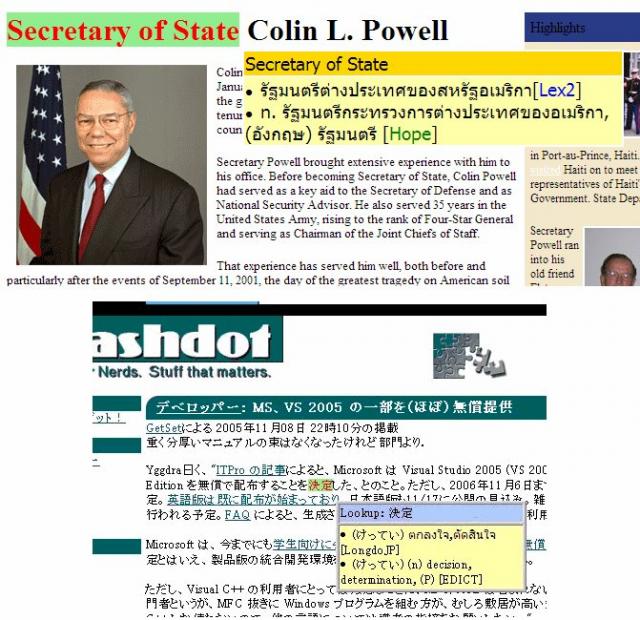
แสดงได้ทั้งความหมายของคำเดี่ยว และคำผสม ได้อย่างถูกต้อง
เช่น Secretary of State=รัฐมนตรีต่างประเทศของสหรัฐฯ (ในภาพตัวอย่าง),
High school=โรงเรียนมัธยมปลาย