You know the meaning of this word? click [add this word] to add this word to our database with its meaning, to impart your knowledge for the general benefit
ติดโพย (PopThai)
Move your mouse over the text to see pop-up windows.
(四苦) (n) {Buddh} the four kinds of suffering (birth, old age, disease, death) [EDICT]
(市区) (n) municipal district; streets [EDICT]
(死苦) (n) (1) {Buddh} (See 四苦) inevitability of death (one of the four kinds of suffering); (2) death pains; agony of death [EDICT]
(詩句) (n,adj-no) verse [EDICT]
(若く) (v5k,vi) (1) (arch) to match; to equal; (2) to catch up with; to overtake [EDICT]
(如く) (v5k,vi) (1) (arch) to match; to equal; (2) to catch up with; to overtake [EDICT]
(及く) (v5k,vi) (1) (arch) to match; to equal; (2) to catch up with; to overtake [EDICT]
(頻く) (v5k,vi) (arch) (is v4k) to occur repeatedly; to be repeated [EDICT]
(敷く) (v5k) (1) to spread out; to lay out; (2) to take a position; (3) (See 法令を敷く) to impose widely (e.g. over a city); (P) [EDICT]
(布く) (v5k) (1) to spread out; to lay out; (2) to take a position; (3) (See 法令を敷く) to impose widely (e.g. over a city); (P) [EDICT]
じ
(字) ตัวอักษร [LongdoJP]
(事) (n) {Buddh} (See 理・2) individual concrete phenomenon (as opposed to a general principle) [EDICT]
(児) (n-suf) child; (P) [EDICT]
(字) (n) (1) character (i.e. kanji); (2) hand-writing; penmanship; (3) (as 〜の字) (See ほの字) the ... word (i.e. "the L word" = "love"); (P) [EDICT]
(寺) (suf,ctr) counter for temples [EDICT]
(時) (suf) (1) hour; o'clock; (suf,adj-no) (2) (See 緊急時) (specified) time; when ...; during ... [EDICT]
(次) (pref) (1) next; (2) (See 次亜) hypo- (i.e. containing an element with low valence); (ctr) (3) order; sequence; time; times [EDICT]
(璽) (n) emperor's seal [EDICT]
(痔) (n) hemorrhoids; piles [EDICT]
(辞) (n) (1) address (e.g. opening or closing remarks); speech; words; (2) ci (Chinese literary form); (3) (See 詞・3) ancillary word [EDICT]
(地) (n) (1) (abbr) ground; land; earth; soil; (2) the region in question; the local area; (3) skin; (4) texture; fabric; material; weave; (5) base; background; (6) one's true nature; (7) narrative (i.e. descriptive part of a story); (8) real life; actuality; (9) (in the game of go) captured territory; (10) (See 地謡) noh chorus; (11) (in Japanese dance) accompaniment music; (12) (in Japanese music) basic phrase (usu. repetitive); (13) base part (of multiple shamisens) [EDICT]
(路) (suf) (1) route; road; (2) distance travelled in a day; (3) (See 七十路) (with decade) one's ....; age .... [EDICT]
() (prt) (abbr) (See かもしれない) may; might; perhaps; may be; possibly [EDICT]
() (prt) (See か,よ) sentence-ending particle expressing doubt [EDICT]
() (prt) (1) from (e.g. time, place, numerical quantity); since; (2) from (originator); (3) because; (4) out of (constituent, part); (5) through (e.g. window, vestibule); (6) after; since (following te-form verb); (P) [EDICT]
(下) (suf) under (being in said condition or environment) [EDICT]
(化) (suf) (See 化する) action of making something; -ification [EDICT]
(果) (n) (1) {Buddh} (See 因・2) phala (attained state, result); (2) {Buddh} (See 悟り・2) enlightenment (as the fruits of one's Buddhist practice); (3) (See 果物) fruit; (ctr) (4) counter for pieces of fruit [EDICT]
(架) (n) unit of equipment; rack [EDICT]
(火) (n) (1) (abbr) (See 火曜) Tuesday; (2) (See 五行・1) fire (second of the five elements) [EDICT]
(荷) (suf,ctr) counter for loads (that can be carried on one's shoulders) [EDICT]
(菓) (n) (1) (arch) fruit; (suf,ctr) (2) counter for fruit [EDICT]
(課) (n,n-suf) (1) lesson; (2) section (in an organization); division; department; (ctr) (3) counter for lessons and chapters (of a book); (P) [EDICT]
(過) (pref) (1) surplus- (attaches to start of Sino-Japanese words); excess-; over-; (2) per- (chemical with more of a certain element than found in other compounds of the same constituents) [EDICT]
(蚊) (n) mosquito; (P) [EDICT]
(香) (n) smell (esp. a good smell); fragrance; scent; aroma; perfume [EDICT]
(日) (n-suf) (1) day of month; (ctr) (2) counter for days [EDICT]
(戈) (n) ge (ancient Chinese dagger-axe) [EDICT]
(顆) (n) (1) condyle; (ctr) (2) (arch) counter for grains and small spheres [EDICT]
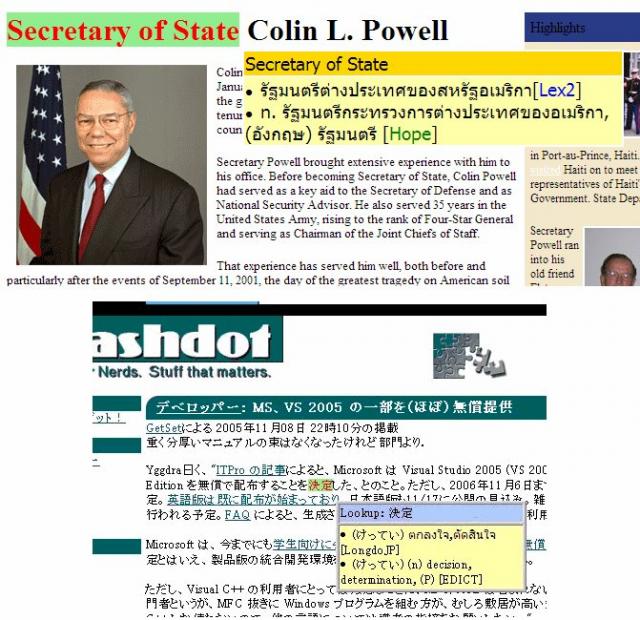
แสดงได้ทั้งความหมายของคำเดี่ยว และคำผสม ได้อย่างถูกต้อง
เช่น Secretary of State=รัฐมนตรีต่างประเทศของสหรัฐฯ (ในภาพตัวอย่าง),
High school=โรงเรียนมัธยมปลาย