(せん) (adj-no,n) (1) former; previous; old; (n) (2) first move (in go, shogi, etc.); opening move [EDICT]
(さき) (n,adj-no,n-suf,pref) (1) previous; prior; former; some time ago; preceding; (2) point (e.g. pencil); tip; end; nozzle; (3) head (of a line); front; (4) ahead; the other side; (5) the future; hereafter; (6) destination; (7) the other party; (P) [EDICT]
(xiān, ㄒㄧㄢ) early; prior; former; in advance; first [CE-DICT]
(おもいやる) (v5r) (See 思いやり) to be considerate; to sympathize with; to sympathise with; (P) [EDICT]
れる
() (aux-v,v, ) (1) (れる for 五段 verbs, られる for 一段. Follows the imperfective form of (v5) and (vs) verbs) (See 未然形,迷惑の受身・めいわくのうけみ) indicates passive voice (inc. the "suffering passive"); (2) (no imperative form. Infrequently used in modern Japanese, e.g. 歩ける is favoured over 歩かれる) (See ら抜き言葉・らぬきことば) indicates the potential form; (3) (no imperative form) indicates spontaneous occurrence; (4) (hon) (no imperative form) used as an honorific for others' actions [EDICT]
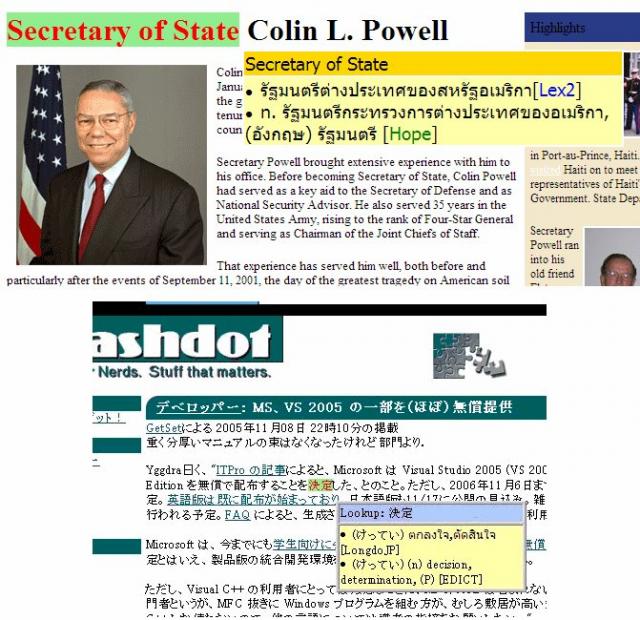
แสดงได้ทั้งความหมายของคำเดี่ยว และคำผสม ได้อย่างถูกต้อง
เช่น Secretary of State=รัฐมนตรีต่างประเทศของสหรัฐฯ (ในภาพตัวอย่าง),
High school=โรงเรียนมัธยมปลาย