You know the meaning of this word? click [add this word] to add this word to our database with its meaning, to impart your knowledge for the general benefit
ติดโพย (PopThai)
Move your mouse over the text to see pop-up windows.
(きる) (suf,v5r,vt) (1) (See 噛み切る) to cut (usu. to cut through); (2) (See 縁を切る) to sever (connections, ties); (3) to turn off (i.e. the light); (4) (See 電話を切る) to terminate (i.e. a conversation); to hang up (the phone); to disconnect; (5) to punch (a ticket); to tear off (a stub); (6) to open (something sealed); (7) to start; (8) to set (a limit); (9) (See 値切る) to reduce; to decrease; to discount; (10) to shake off (water, etc.); to let drip-dry (or drain); (11) to cross; (12) to do (something noticeable); (13) to turn (a vehicle); (14) to cut (the ball); (15) to shuffle (cards); (16) (See 切り札) to trump; (17) (in Go) to isolate (an opponent's stone); (suf,v5r) (18) (See 疲れきる) (after the -masu stem of a verb) to finish; to complete; (P) [EDICT]
て
() (conj) (col) (See と言うか) or rather (say); or better (say); or perhaps I should say; or, how should I put it,...; I mean [EDICT]
() (prt) a sort of thing like; used after a phrase to modify the following noun [EDICT]
() (prt) (1) (also でも, っても) even if; even though; (int) (2) (abbr) (See さても) wow [EDICT]
(手) (n) (1) (occ. pronounced た when a prefix) (See お手・おて・1) hand; arm; (2) (col) (See お手・おて・3) forepaw; foreleg; (3) handle; (4) hand; worker; help; (5) trouble; care; effort; (6) means; way; trick; move; technique; workmanship; (7) hand; handwriting; (8) kind; type; sort; (9) (See 手に入る) one's hands; one's possession; (10) (See 手に余る) ability to cope; (11) hand (of cards); (12) (See 山の手・1) direction; (P) [EDICT]
は
(葉) ใบไม้ [LongdoJP]
() (int) (1) (pol) yes; (2) OK (used to get attention prior to an utterance); okay; (3) giddy-up; giddap; (P) [EDICT]
(破) (n) (See 序破急) (in gagaku or noh) middle section of a song [EDICT]
(葉) (n) leaf; (P) [EDICT]
切れる
(きれる) (v1,vi) (1) to break; to snap; to be cut; to split; to crack; (2) to be injured; (3) to wear out; to be worn out; (4) to break; to burst; to collapse; (5) to wear off; to stop working; to go dead; (6) to expire (time limit, etc.); to run out; to become due; (7) to run out (of stock, etc.); to be exhausted; to be used up; to be sold out; to be out of; (8) to be broken off (e.g. of a relationship); to break up; to have severed ties; to be cut off; to be disconnected; (9) to cut well; to be sharp; (10) to be sharp-minded; to be keen; to be shrewd; to be quick-witted; to be able; (11) to be short of; to drop under (a certain figure); to beat (e.g. a record time); (12) to dry off; (13) to curve; to veer; (14) to shuffle (cards); (15) (col) (See キレる) to get angry; to snap; to blow one's top; to lose one's temper; to flip; (suf,v1) (16) to be able to do completely; (P) [EDICT]
ない
() (exp) (1) (See ませんか) (used to ask a question in the negative) won't (hasn't, isn't, doesn't, etc.); (2) (used to make invitations, express desires or give indirect commands) won't you [EDICT]
() (conj,aux) (1) (See ない) without doing ...; (aux) (2) used in sentence-final position as an indirect prohibition [EDICT]
(内) (suf) inside; within [EDICT]
(亡い) (adj-i) (See 無い) dead [EDICT]
(無い) (adj-i) (1) (uk) (See 亡い) nonexistent; not being (there); (2) unpossessed; unowned; not had; (3) (See またとない) unique; (4) (as ...ことがない, etc.) indicates negation, inexperience, unnecessariness or impossibility; (aux-adj) (5) (See ない) (after the ren'youkei form of an adjective) not ...; (6) (after the -te form of a verb) to not be...; to have not ...; (P) [EDICT]
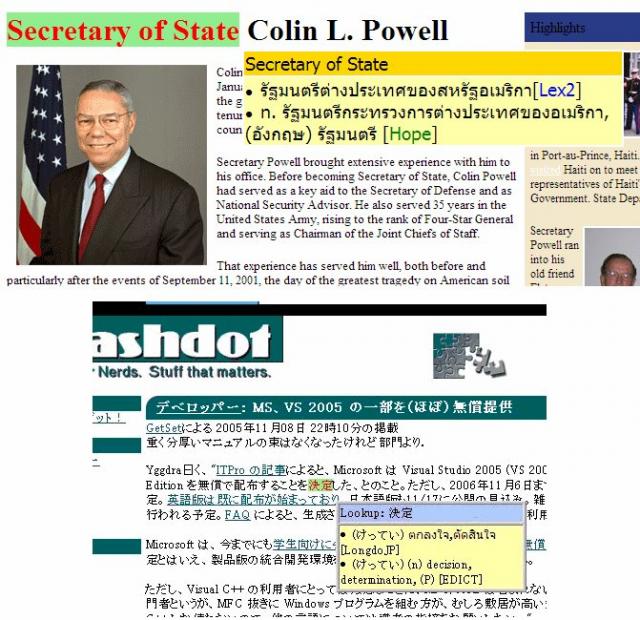
แสดงได้ทั้งความหมายของคำเดี่ยว และคำผสม ได้อย่างถูกต้อง
เช่น Secretary of State=รัฐมนตรีต่างประเทศของสหรัฐฯ (ในภาพตัวอย่าง),
High school=โรงเรียนมัธยมปลาย