(りつ) (n) (1) law (esp. ancient East Asian criminal code); regulation; (2) {Buddh} vinaya (rules for the monastic community); (3) (abbr) (See 律宗) Ritsu (school of Buddhism); (4) (abbr) (See 律詩) lushi (style of Chinese poem); (5) (also りち) (musical) pitch; (6) (See 十二律,呂) six odd-numbered notes of the ancient chromatic scale; (7) (abbr) (See 律旋) Japanese seven-tone gagaku scale, similar to Dorian mode (corresponding to [EDICT]
(lǜ, ㄌㄩˋ) law [CE-DICT]
動
(どう) (n) motion; change; confusion; (P) [EDICT]
(dòng, ㄉㄨㄥˋ) to use; to act; to move; to change [CE-DICT]
的
(てき) (adj-na,suf) -like; typical; (P) [EDICT]
(まと) (n) mark; target; (P) [EDICT]
(de, ㄉㄜ˙) of; structural particle: used before a noun, linking it to preceding possessive or descriptive attributive [CE-DICT]
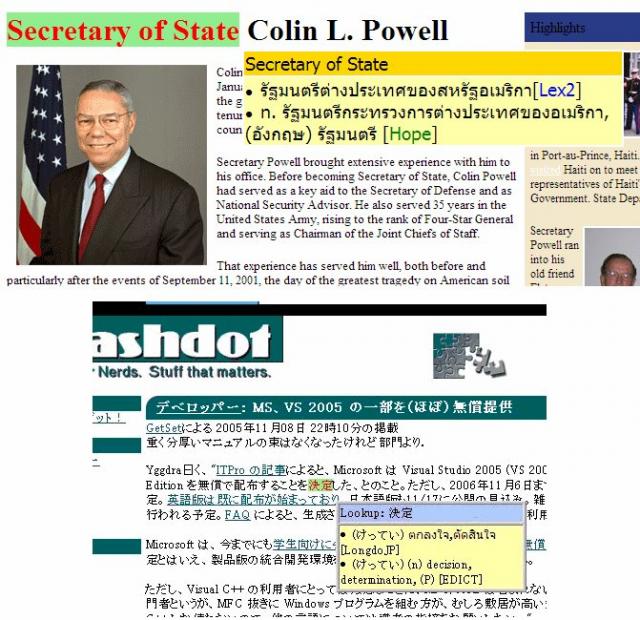
แสดงได้ทั้งความหมายของคำเดี่ยว และคำผสม ได้อย่างถูกต้อง
เช่น Secretary of State=รัฐมนตรีต่างประเทศของสหรัฐฯ (ในภาพตัวอย่าง),
High school=โรงเรียนมัธยมปลาย