You know the meaning of this word? click [add this word] to add this word to our database with its meaning, to impart your knowledge for the general benefit
ติดโพย (PopThai)
Move your mouse over the text to see pop-up windows.
(理) (n) (1) reason; principle; logic; (2) {Buddh} (See 事・じ) general principle (as opposed to individual concrete phenomenon); (3) (in neo-Confucianism) the underlying principles of the cosmos; (P) [EDICT]
(里) (n) (1) ri (old Japanese unit of distance, approx. 3.927km or 2.44 miles); (2) (See 郷里制,国郡里制) neighbourhood (under the ritsuryo system; orig. of 50 homes); (3) (See 条里制) unit of area (approx. 654m by 654m); (P) [EDICT]
(離) (n) li (one of the trigrams of the I Ching [EDICT]
人
(じん) (suf) (1) -ian (e.g. Italian, etc.) (attaches to name of country to denote nationality); -er (e.g. performer, etc.) (attaches to name of occupation); (2) (usu. in compound words) man; person; people; (P) [EDICT]
(と) (suf) person [EDICT]
(にん(P);たり;り) (ctr) (1) counter for people; (n) (2) (にん only) (usu. in compound words) person; (P) [EDICT]
(ひと) (n) (1) man; person; (2) human being; mankind; people; (3) character; personality; (4) man of talent; true man; (5) other people; (6) adult; (P) [EDICT]
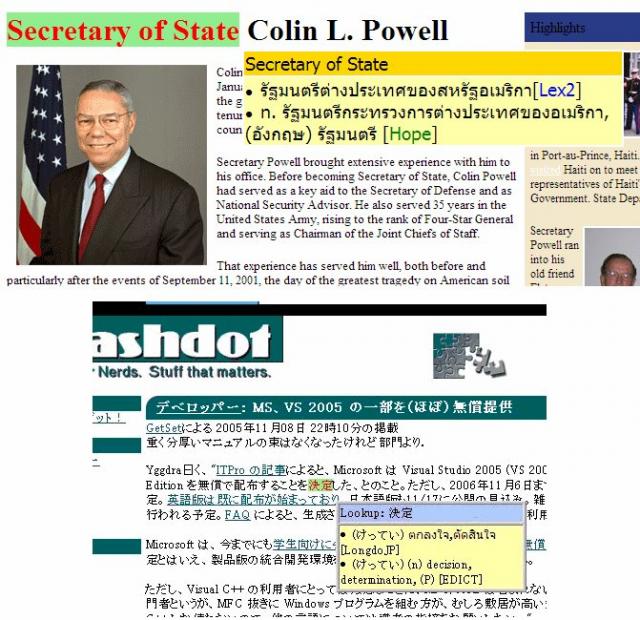
แสดงได้ทั้งความหมายของคำเดี่ยว และคำผสม ได้อย่างถูกต้อง
เช่น Secretary of State=รัฐมนตรีต่างประเทศของสหรัฐฯ (ในภาพตัวอย่าง),
High school=โรงเรียนมัธยมปลาย