[あごでひとをつかう, agodehitowotsukau] (exp, v5u) (See あごで使う・1) to set somebody to work in an arrogant fashion; to push somebody around; to indicate someone by pointing one's chin [Add to Longdo]
You know the meaning of this word? click [add this word] to add this word to our database with its meaning, to impart your knowledge for the general benefit
ติดโพย (PopThai)
Move your mouse over the text to see pop-up windows.
() (aux) (pol) (See だ・1) polite copula in Japanese; (P) [EDICT]
() (conj,int) (See それでは) then; well; so; well then; (P) [EDICT]
() (conj) (1) but; however; though; nevertheless; still; yet; even so; (prt) (2) even; (3) however; no matter how; even if; even though; (4) ... or something; (5) (as 〜でも〜でも) either ... or ...; neither ... nor ...; (pref) (6) (before an occupation, etc.) pseudo-; quack; in-name-only; (7) (before an occupation, etc.) (See でもしか) for lack of anything better to do; (P) [EDICT]
(出) (n,n-suf) (1) coming out; going out; outflow; efflux; rising (of the sun or moon); (2) attending (work); appearing (on stage); one's turn to go on; (3) start; beginning; (4) origins; background; person (or item) originating from ...; graduate of ...; native of ...; member of ... (lineage); (5) architectural member that projects outward; (6) highest point of the stern of a ship; (7) (uk) (usu. after the -masu stem of a verb as 〜出がある or 〜出がない, etc.) amount (comprising something); amount of time or effort required to do something; (P) [EDICT]
人
(じん) (suf) (1) -ian (e.g. Italian, etc.) (attaches to name of country to denote nationality); -er (e.g. performer, etc.) (attaches to name of occupation); (2) (usu. in compound words) man; person; people; (P) [EDICT]
(と) (suf) person [EDICT]
(にん(P);たり;り) (ctr) (1) counter for people; (n) (2) (にん only) (usu. in compound words) person; (P) [EDICT]
(ひと) (n) (1) man; person; (2) human being; mankind; people; (3) character; personality; (4) man of talent; true man; (5) other people; (6) adult; (P) [EDICT]
(rén, ㄖㄣˊ) man; person; people [CE-DICT]
を
() (prt) (arch) (See を) marks object of action, etc. (also adds emphasis) [EDICT]
使う
(つかう) ใช้ [LongdoJP]
(つかう) (v5u,vt) (1) to use (a thing, method, etc.); to make use of; to put to use; (2) (See 人使い) to use (a person, animal, puppet, etc.); to employ; to handle; to manage; to manipulate; (3) to use (time, money, etc.); to spend; to consume; (4) (See 言葉遣い) to use (language); to speak; (5) (id) to take (one's lunch); to circulate (bad money); (P) [EDICT]
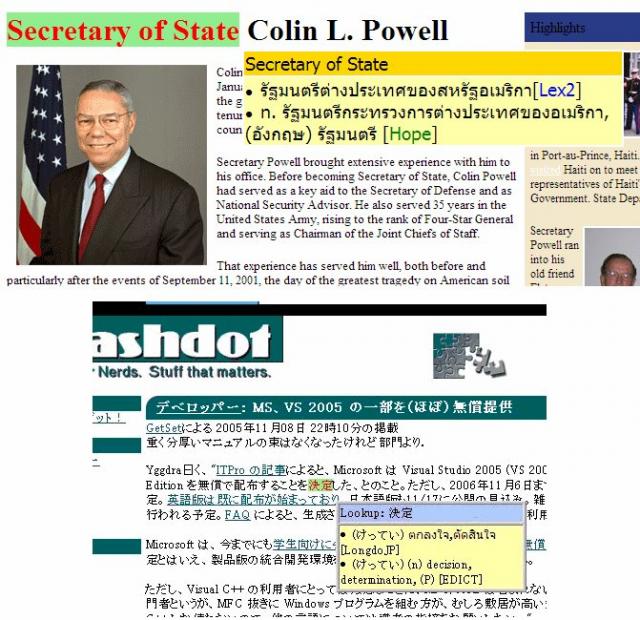
แสดงได้ทั้งความหมายของคำเดี่ยว และคำผสม ได้อย่างถูกต้อง
เช่น Secretary of State=รัฐมนตรีต่างประเทศของสหรัฐฯ (ในภาพตัวอย่าง),
High school=โรงเรียนมัธยมปลาย