(n) an inactive substance that is a vehicle for a radioactive tracer of the same substance and that assists in its recovery after some chemical reaction
(n) (genetics) an organism that possesses a recessive gene whose effect is masked by a dominant allele; the associated trait is not apparent but can be passed on to offspring
n. [ From Carry. ] 1. One who, or that which, carries or conveys; a messenger. [ 1913 Webster ]
The air which is but . . . a carrier of the sounds. Bacon. [ 1913 Webster ]
2. One who is employed, or makes it his business, to carry goods for others for hire; a porter; a teamster. [ 1913 Webster ]
The roads are crowded with carriers, laden with rich manufactures. Swift. [ 1913 Webster ]
3. (Mach.) That which drives or carries; as: (a) A piece which communicates to an object in a lathe the motion of the face plate; a lathe dog. (b) A spool holder or bobbin holder in a braiding machine. (c) A movable piece in magazine guns which transfers the cartridge to a position from which it can be thrust into the barrel. [ 1913 Webster ]
Carrier pigeon (Zool.), a variety of the domestic pigeon used to convey letters from a distant point to to its home. -- Carrier shell (Zool.), a univalve shell of the genus Phorus; -- so called because it fastens bits of stones and broken shells to its own shell, to such an extent as almost to conceal it. -- Common carrier (Law.) See under Common, a. [ 1913 Webster ]
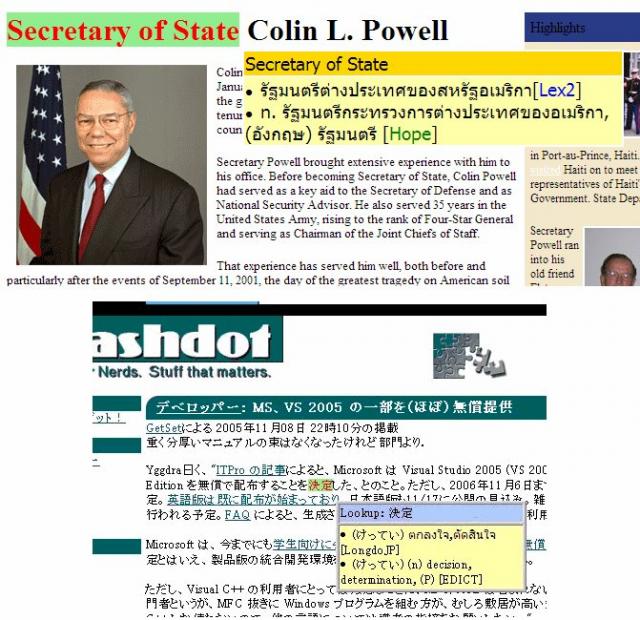
แสดงได้ทั้งความหมายของคำเดี่ยว และคำผสม ได้อย่างถูกต้อง
เช่น Secretary of State=รัฐมนตรีต่างประเทศของสหรัฐฯ (ในภาพตัวอย่าง),
High school=โรงเรียนมัธยมปลาย