n. [ Cf. F. lithographie. ] 1. The art or process of putting designs or writing, with a greasy material, on stone, and of producing printed impressions therefrom. The process depends, in the main, upon the antipathy between grease and water, which prevents a printing ink containing oil from adhering to wetted parts of the stone not covered by the design. See Lithographic limestone, under Lithographic. [ 1913 Webster ]
2. a printing process for reproducing images, using any flat surface, such as a metal plate, in a manner similar to lithography{ 1 }. [ PJC ]
3. The process of producing patterns on semiconductor crystals by exposing photosensitive coatings on a matrix, such as silicon, to light patterns in the form desired for the circuit, and subsequently treating (e.g., chemically) the patterns thus formed in such a way as to create integrated semiconductor circuits with the desired properties. This is the principle method (1990's) to create the high-density integrated circuits used in the digital computers on which you are reading this. [ PJC ]
n. 1. The art or process of producing photolithographs. [ 1913 Webster ]
2. The process by which the image of a pattern is transferred photographically to a sensitive surface, and the surface subsequently etched; used for printing or in the production of integrated circuits. [ PJC ]
n. [ Gr. &unr_; type + lithography. ] A branch of lithography in which impressions from printers' types are transferred to stone for reproduction. -- Ty`po*lith`o*graph"ic a.
You know the meaning of this word? click [add this word] to add this word to our database with its meaning, to impart your knowledge for the general benefit
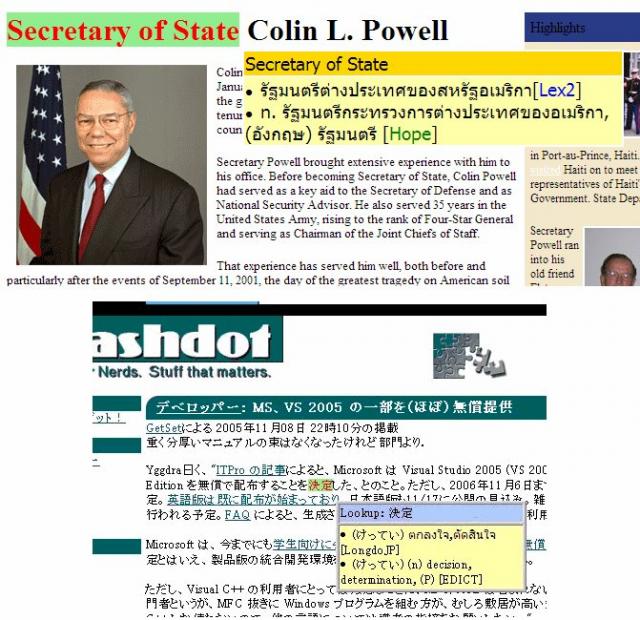
แสดงได้ทั้งความหมายของคำเดี่ยว และคำผสม ได้อย่างถูกต้อง
เช่น Secretary of State=รัฐมนตรีต่างประเทศของสหรัฐฯ (ในภาพตัวอย่าง),
High school=โรงเรียนมัธยมปลาย