(adj) derived from experiment and observation rather than theory, Syn.empiric, Ant.theoretical, Example: an empirical basis for an ethical theory; empirical laws; empirical data; an empirical treatment of a disease about which little is known
n. [ L. empiricus an empiric, Gr. &unr_; experienced, equiv. to &unr_;; &unr_; in + &unr_; a trial, experiment; akin to &unr_; ford, way, and E. fare: cf. F. empirique. See In, and Fare. ] 1. One who follows an empirical method; one who relies upon practical experience. [ 1913 Webster ]
2. One who confines himself to applying the results of mere experience or his own observation; especially, in medicine, one who deviates from the rules of science and regular practice; an ignorant and unlicensed pretender; a quack; a charlatan. [ 1913 Webster ]
Among the Greek physicians, those who founded their practice on experience called themselves empirics. Krauth-Fleming. [ 1913 Webster ]
Swallow down opinions as silly people do empirics' pills. Locke.
{ } a. 1. Pertaining to, or founded upon, experiment or experience; depending upon the observation of phenomena; versed in experiments. [ 1913 Webster ]
In philosophical language, the term empirical means simply what belongs to or is the product of experience or observation. Sir W. Hamilton. [ 1913 Webster ]
The village carpenter . . . lays out his work by empirical rules learnt in his apprenticeship. H. Spencer. [ 1913 Webster ]
2. Depending upon experience or observation alone, without due regard to science and theory; -- said especially of medical practice, remedies, etc.; wanting in science and deep insight; as, empiric skill, remedies. [ 1913 Webster ]
n. 1. The method or practice of an empiric; pursuit of knowledge by observation and experiment. [ 1913 Webster ]
2. Specifically, a practice of medicine founded on mere experience, without the aid of science or a knowledge of principles; ignorant and unscientific practice; charlatanry; quackery. [ 1913 Webster ]
3. (Metaph.) The philosophical theory which attributes the origin of all our knowledge to experience. [ 1913 Webster ]
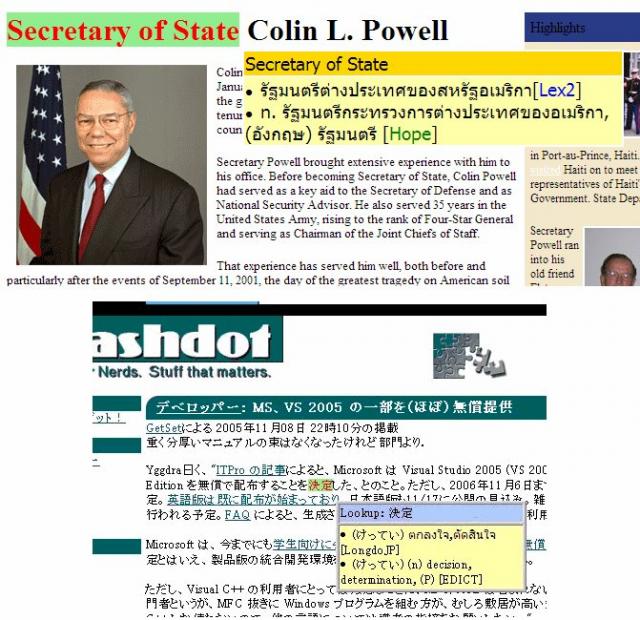
แสดงได้ทั้งความหมายของคำเดี่ยว และคำผสม ได้อย่างถูกต้อง
เช่น Secretary of State=รัฐมนตรีต่างประเทศของสหรัฐฯ (ในภาพตัวอย่าง),
High school=โรงเรียนมัธยมปลาย