a. [ Hexa- + basic. ] (Chem.) Having six hydrogen atoms or six radicals capable of being replaced or saturated by bases; -- said of acids; as, mellitic acid is hexabasic. [ 1913 Webster ]
n. [ Hexa- + Gr. &unr_; string, chord: cf. F. hexacorde. ] (Mus.) A series of six notes, with a semitone between the third and fourth, the other intervals being whole tones. [ 1913 Webster ]
a. [ Hex- + acid. ] (Chem.) Having six atoms or radicals capable of being replaced by acids; hexatomic; hexavalent; -- said of bases; as, mannite is a hexacid base. [ 1913 Webster ]
a. [ From NL. Hexactinellinæ, fr. Gr. "e`x six + a dim. of &unr_;, &unr_;, a ray.] (Zool.) Belonging to the Hexactinellinæ, a group of sponges, having six-rayed siliceous spicules. [1913 Webster]
n. [ L. hexas, hexadis, the number six, Gr. &unr_;, &unr_;, fr. "e`x six.] (chem.) An atom whose valence is six, and which can be theoretically combined with, substituted for, or replaced by, six monad atoms or radicals; as, sulphur is a hexad in sulphuric acid. Also used as an adjective. [1913 Webster]
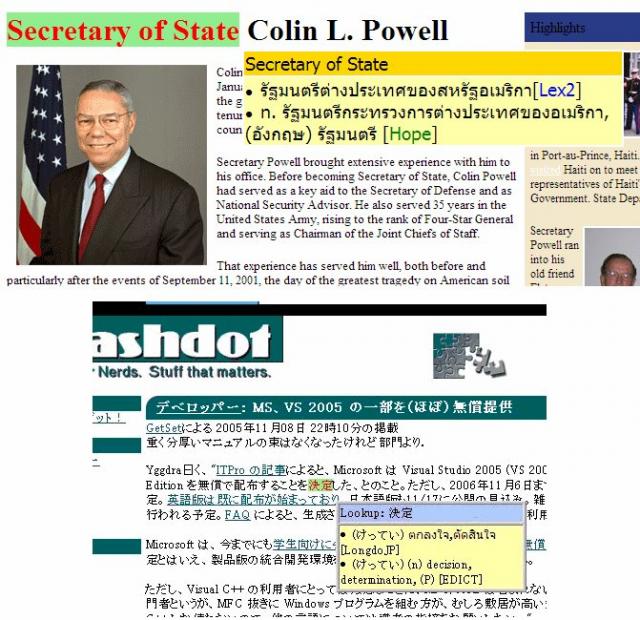
แสดงได้ทั้งความหมายของคำเดี่ยว และคำผสม ได้อย่างถูกต้อง
เช่น Secretary of State=รัฐมนตรีต่างประเทศของสหรัฐฯ (ในภาพตัวอย่าง),
High school=โรงเรียนมัธยมปลาย