v. t. [ imp. & p. p. Statued p. pr. & vb. n. Statuing. ] To place, as a statue; to form a statue of; to make into a statue. “The whole man becomes as if statued into stone and earth.” Feltham. [ 1913 Webster ]
n. [ F., fr. L. statua (akin to stativus standing still), fr. stare, statum, to stand. See Stand. ] 1. The likeness of a living being sculptured or modeled in some solid substance, as marble, bronze, or wax; an image; as, a statue of Hercules, or of a lion. [ 1913 Webster ]
I will raise her statue in pure gold. Shak. [ 1913 Webster ]
a. Partaking of, or exemplifying, the characteristics of a statue; having the symmetry, or other excellence, of a statue artistically made; as, statuesquelimbs; a statuesque attitude. [ 1913 Webster ]
Their characters are mostly statuesque even in this respect, that they have no background. Hare. [ 1913 Webster ]
n. [ F., cf. It. statuetta. ] A small statue; -- usually applied to a figure much less than life size, especially when of marble or bronze, or of plaster or clay as a preparation for the marble or bronze, as distinguished from a figure in terra cotta or the like. Cf. Figurine. [ 1913 Webster ]
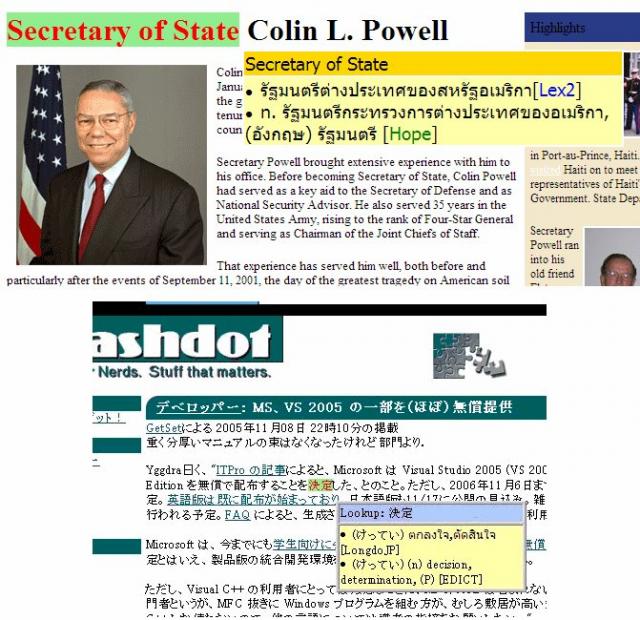
แสดงได้ทั้งความหมายของคำเดี่ยว และคำผสม ได้อย่างถูกต้อง
เช่น Secretary of State=รัฐมนตรีต่างประเทศของสหรัฐฯ (ในภาพตัวอย่าง),
High school=โรงเรียนมัธยมปลาย