n. [ L. apologous, Gr. &unr_;; &unr_; from + &unr_; speech, &unr_; to speak: cf. F. apologue. ] A story or relation of fictitious events, intended to convey some moral truth; a moral fable. [ 1913 Webster ]
☞ An apologue differs from a parable in this;: the parable is drawn from events which take place among mankind, and therefore requires probability in the narrative; the apologue is founded on supposed actions of brutes or inanimate things, and therefore is not limited by strict rules of probability. Æsop's fables are good examples of apologues. [ 1913 Webster ]
n. [ F. &unr_;, fr. Gr. &unr_;. ] 1. That which is analogous to, or corresponds with, some other thing. [ 1913 Webster ]
The vexatious tyranny of the individual despot meets its analogue in the insolent tyranny of the many. I. Taylor. [ 1913 Webster ]
2. (Philol.) A word in one language corresponding with one in another; an analogous term; as, the Latin “pater” is the analogue of the English “father.” [ 1913 Webster ]
3. (Nat. Hist.) (a) An organ which is equivalent in its functions to a different organ in another species or group, or even in the same group; as, the gill of a fish is the analogue of a lung in a quadruped, although the two are not of like structural relations. (b) A species in one genus or group having its characters parallel, one by one, with those of another group. (c) A species or genus in one country closely related to a species of the same genus, or a genus of the same group, in another: such species are often called representative species, and such genera, representative genera. Dana. [ 1913 Webster ]
(adj) of a circuit or device having an output that is proportional to the input, Syn.analog, linear, Ant.digital, Example: analogue device; linear amplifier
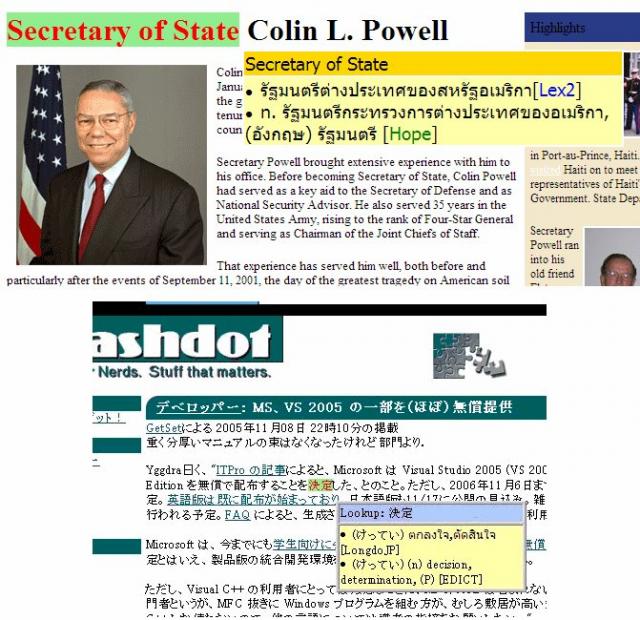
แสดงได้ทั้งความหมายของคำเดี่ยว และคำผสม ได้อย่างถูกต้อง
เช่น Secretary of State=รัฐมนตรีต่างประเทศของสหรัฐฯ (ในภาพตัวอย่าง),
High school=โรงเรียนมัธยมปลาย