(n) United States industrialist who built the first American locomotive; founded Cooper Union in New York City to offer free courses in the arts and sciences (1791-1883), Syn.Peter Cooper
(n) a jointly owned commercial enterprise (usually organized by farmers or consumers) that produces and distributes goods and services and is run for the benefit of its owners, Syn.co-op
v. i. [ imp. & p. p. Cooperated; p. pr. & vb. n. Cooperating. ] [ L. cooperatus, p. p. of cooperari to cooperate; co + operari to work, opus work. See Operate. ] To act or operate jointly with another or others; to concur in action, effort, or effect. [ 1913 Webster ]
Whate'er cooperates to the common mirth. Crashaw. [ 1913 Webster ]
n. [ L. cooperatio: cf. F. coopération. ] 1. The act of cooperating, or of operating together to one end; joint operation; concurrent effort or labor. [ 1913 Webster ]
Not holpen by the cooperation of angels. Bacon. [ 1913 Webster ]
2. (Polit. Econ.) The association of a number of persons for their benefit. [ 1913 Webster ]
a. Operating jointly to the same end. [ 1913 Webster ]
Cooperative society, a society established on the principle of a joint-stock association, for the production of commodities, or their purchase and distribution for consumption, or for the borrowing and lending of capital among its members. -- Cooperative store, a store established by a cooperative society, where the members make their purchases and share in the profits or losses. [ 1913 Webster ]
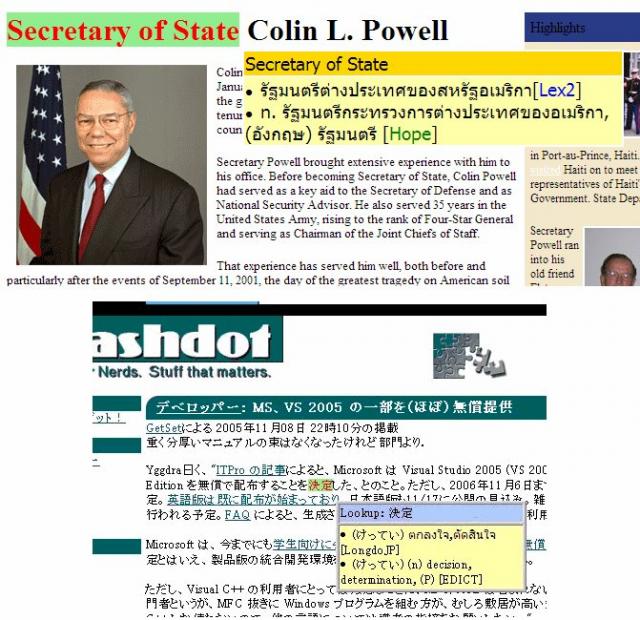
แสดงได้ทั้งความหมายของคำเดี่ยว และคำผสม ได้อย่างถูกต้อง
เช่น Secretary of State=รัฐมนตรีต่างประเทศของสหรัฐฯ (ในภาพตัวอย่าง),
High school=โรงเรียนมัธยมปลาย