ลองค้นหาคำในรูปแบบอื่น ๆ เพื่อให้ได้ผลลัพธ์มากขึ้นหรือน้อยลง: -dde-, *dde*
Possible hiragana form: っで |
มีผลลัพธ์ที่ไม่แสดงผลอยู่ | dde | (ดีดีอี) ย่อมาจาก dynamic data exchange คำนี้ใช้ในระบบไมโครซอฟต์วินโดว์และโอเอส/ทู หมายถึงการทำให้สองโปรแกรมบนวินโดว์ สามารถใช้ข้อมูลร่วมกันได้ เป็นต้นว่า การนำตัวเลขที่อยู่ในโปรแกรมตารางจัดการ (spreadsheet) มาใช้ในโปรแกรมประมวลผลคำ (word processing) ได้ โดยไม่ต้องเสียเวลาพิมพ์ตัวเลขเหล่านั้นใหม่ นอกจากนั้น หากมีการแก้ไขตัวเลขในตารางจัดการ ตัวเลขในโปรแกรมประมวลผลคำ ก็จะได้รับการแก้ไขไปด้วยโดยอัตโนมัติ | | accommodation ladder | บันไดข้างกาบเรือ | | addend | (แอด' เดนดฺ) n. เลขหรือจำนวนที่บวกเข้าด้วยกัน | | addendum | (อะเดน' เดิม) n. (pl. -da) สิ่งที่เพิ่มเข้า, การเพิ่มหรือบวกเข้า, ภาคผนวก | | adder 1 | (แอด' เดอะ) n. ผู้บวก, ตัวบวก | | adder 2 | (แอด' เดอะ) n. งูพิษชนิดหนึ่งในในยุโรป | | adder's-tongue | (แอด' เดอซทัง) n. ต้นเฟิร์นชนิดหนึ่ง (Ophioglossum) (a fern) | | aerial ladder | บรรไดยาที่ยึดออกได้ (มักติดกับรถ) | | air bladder | ถุงลม, กระเพาะปลา., Syn. gas bladder, swim bladder | | bedridden | (เบด'ริดเดน) adj. ล้มหมอนนอนเสื่อ, ล้มป่วย, Syn. ailing |
| |
| | shredder | (n) เครื่องทำลายเอกสาร | | goddess of mercy | (n) เจ้าแม่กวนอิม, เทพเจ้าแห่งความเมตตา (ซึ่งหมายถึงเจ้าแม่กวนอิม โดยในภาษาอื่นอาจเรียกกันไปในหลายๆ คำ เช่น Quan Yin, Kuan Yim เป็นต้น)
Image: 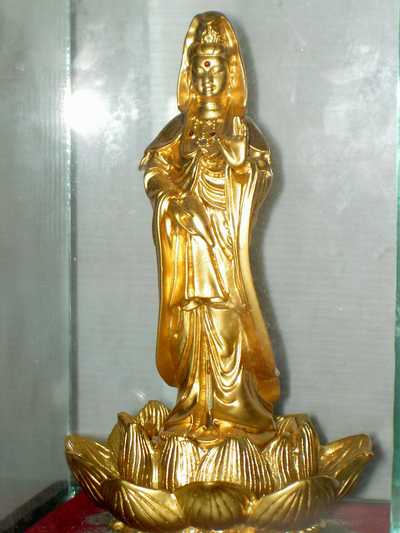 |
| | addendum | (n) ภาคผนวก, บทเสริม, บทต่อท้าย | | adder | (n) อสรพิษ | | bedridden | (adj) ล้มหมอนนอนเสื่อ, ล้มป่วย, เจ็บเรื้อรัง | | bladder | (n) กระเพาะปัสสาวะ | | fodder | (n) หญ้าแห้ง, ฟาง, อาหารสัตว์ | | forbidden | (adj) ซึ่งต้องห้าม, ซึ่งถูกห้าม, ซึ่งไม่ได้รับอนุญาต | | forbidden | (vt pp ของ) forbid | | gladden | (vt) ทำให้ยินดี, ทำให้ดีใจ, ทำให้ปลื้มปีติ | | goddess | (n) เทพธิดา, นางฟ้า, นางสวรรค์, นางอัปสร | | hidden | (vt pp ของ) hide |
| | บันได | [bandai] (n) EN: ladder FR: échelle [ f ] | | บันไดลิง | [bandai ling] (n, exp) EN: fixed ladder FR: passerelle [ f ] | | บันไดหนีไฟ | [bandai nī fai] (n, exp) EN: ladder; steel sadder FR: échelle métallique [ f ] | | เฉลียว | [chalīo] (v) EN: realize suddenly ; have an intuition ; be perceptive ; discern ; be shrewd FR: avoir une intuition ; réaliser soudainement ; se rendre compte | | ชะงัก | [cha-ngak] (v) EN: come to a sudden stop ; stop short ; balk ; be halted ; interrupt ; stop ; halte ; pause ; break off FR: s'arrêter brutalement ; s'interrompre ; stopper ; s'arrêter ; être enrayé | | ฉับ | [chap] (adv) EN: abruptly ; suddenly ; expeditiously ; immediately ; promptly ; speedily ; quickly FR: soudainement ; abruptement | | ฉับพลัน | [chapphlan] (adv) EN: at once ; abruptly ; all of a sudden ; promptly ; suddenly FR: sur le champ ; instantanément ; soudainement ; subitement ; brusquement | | เฉียบพลัน | [chīepphlan] (adv) EN: suddenly ; forcefully ; unexpectedly ; abruptly | | ดับวูบ | [dap wūp] (v, exp) EN: go out suddenly FR: disparaître soudainement | | ดี | [dī] (n) EN: gallbladder ; bile ; gall FR: bile [ f ] ; fiel [ m ] |
| | 誠(P);実 | [まこと, makoto] (adv, n) (1) truth; reality; (2) sincerity; honesty; integrity; fidelity; (3) (arch) that's right (used when recalling forgotten information, suddenly changing the subject, etc.); (P) #1,760 [Add to Longdo] | | 関 | [ぜき, zeki] (suf) (hon) (abbr) (See 関取) honorific added to names of makuuchi and juryo division sumo wrestlers #1,952 [Add to Longdo] | | 野(P);埜 | [の(P);や;ぬ(ok), no (P); ya ; nu (ok)] (n) (1) plain; field; (2) (の only) hidden (structural) member; (n-pref) (3) (の only) (See 野ウサギ・2) wild; (4) (や only) lacking a political post; (P) #2,112 [Add to Longdo] | | 貴 | [むち, muchi] (n, n-suf) (hon) (arch) lord; god; goddess; honorific title for deities (and high-ranking people) #2,288 [Add to Longdo] | | 急 | [きゅう, kyuu] (adj-na) (1) urgent; sudden; abrupt; (2) sharp; steep; precipitous; (3) rapid; swift; fast; (n) (4) emergency; crisis; (5) hurrying; haste; (6) (See 序破急) (in gagaku or noh) end of a song; (P) #3,744 [Add to Longdo] | | 突然 | [とつぜん, totsuzen] (adj-na, adj-no, adv) abrupt; sudden; unexpected; all at once; (P) #4,312 [Add to Longdo] | | 女神 | [めがみ(P);じょしん, megami (P); joshin] (n) goddess; (P) #4,378 [Add to Longdo] | | 隠し | [かくし, kakushi] (pref) (1) hidden; secret; concealed; (2) pocket #4,491 [Add to Longdo] | | 逆転(P);逆点(iK) | [ぎゃくてん, gyakuten] (n, vs, adj-no) (sudden) change; reversal; turn-around; coming from behind (baseball); (P) #4,608 [Add to Longdo] | | バン | [ban] (n) (1) bun; (2) van (caravan); (3) { comp } value-added network; VAN; (P) #4,818 [Add to Longdo] |
| | 2進加算器 | [2しんかさんき, 2 shinkasanki] binary adder [Add to Longdo] | | けた上げ保留加算機 | [けたあげほりゅうかさんき, ketaagehoryuukasanki] carry-save adder [Add to Longdo] | | アナログ加算器 | [アナログかさんき, anarogu kasanki] summer, analog adder [Add to Longdo] | | バン | [ばん, ban] bun, van (caravan), VAN (value-added network) [Add to Longdo] | | フラッディング | [ふらっでいんぐ, furaddeingu] flooding [Add to Longdo] | | ヘッディング開始 | [ヘッディングかいし, heddeingu kaishi] start of heading (SOH) [Add to Longdo] | | マルチスレッディング | [まるちすれっでいんぐ, maruchisureddeingu] multithreading [Add to Longdo] | | ラダー | [らだー, rada-] rudder, ladder (PLC programming paradigm) [Add to Longdo] | | 隠しファイル | [かくしファイル, kakushi fairu] hidden file [Add to Longdo] | | 隠れマルコフモデル | [かくれマルコフモデル, kakure marukofumoderu] hidden Markov model [Add to Longdo] |
|
เพิ่มคำศัพท์
ทราบความหมายของคำศัพท์นี้? กด [เพิ่มคำศัพท์] เพื่อใส่คำนี้พร้อมความหมาย เพื่อเป็นวิทยาทานแก่ผู้ใช้ท่านอื่น ๆ
Are you satisfied with the result?
Discussions | |
|