(adj) consisting of elements that are not of the same kind or nature, Syn.heterogenous, Ant.homogeneous, Example: the population of the United States is vast and heterogeneous
The Collaborative International Dictionary of English (GCIDE) v.0.53
a. [ Gr. &unr_;; &unr_; + &unr_; race, kind; akin to E. kin: cf. F. hétérogène. ] Differing in kind; having unlike qualities; possessed of different characteristics; dissimilar; -- opposed to homogeneous, and said of two or more connected objects, or of a conglomerate mass, considered in respect to the parts of which it is made up. -- Het`er*o*ge"ne*ous*ly, adv. -- Het`er*o*ge"ne*ous*ness, n. [ 1913 Webster ]
Heterogeneous nouns (Gram.), nouns having different genders in the singular and plural numbers; as, hic locus, of the masculine gender in the singular, and hi loci and hæc loca, both masculine and neuter in the plural; hoc cælum, neuter in the singular; hi cæli, masculine in the plural. -- Heterogeneous quantities (Math.), such quantities as are incapable of being compared together in respect to magnitude, and surfaces and solids. -- Heterogeneous surds (Math.), surds having different radical signs. [ 1913 Webster ]
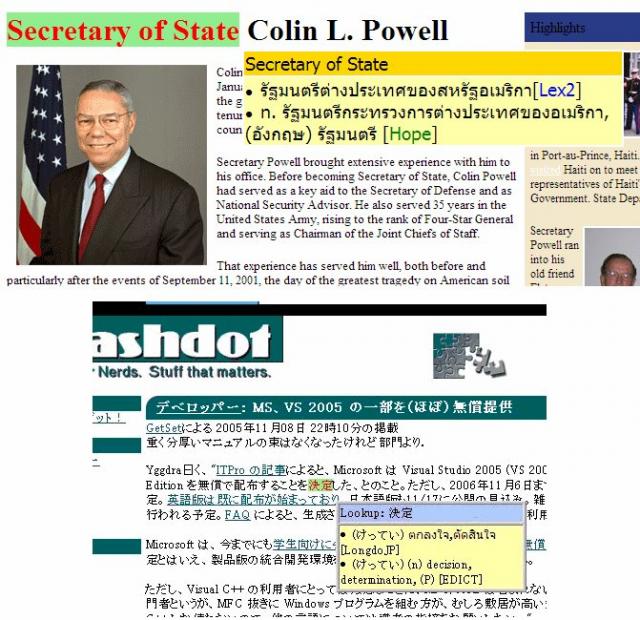
แสดงได้ทั้งความหมายของคำเดี่ยว และคำผสม ได้อย่างถูกต้อง
เช่น Secretary of State=รัฐมนตรีต่างประเทศของสหรัฐฯ (ในภาพตัวอย่าง),
High school=โรงเรียนมัธยมปลาย