v. t. [ imp. & p. p. Isolated p. pr. & vb. n. Isolating ] [ It. isolato, p. p. of isolare to isolate, fr. isola island, L. insula. See 2d Isle, and cf. Insulate. ] [ 1913 Webster ]
1. To place in a detached situation; to place by itself or alone; to insulate; to separate from others; as, to isolate an infected person from others; to isolate the troublemakers in a classroom. [ 1913 Webster +PJC ]
Short isolated sentences were the mode in which ancient wisdom delighted to convey its precepts. Bp. Warburton. [ 1913 Webster ]
2. (Elec.) To insulate. See Insulate. [ 1913 Webster ]
3. (Chem.) To separate (a substance) from all foreign substances; to make pure; to obtain in a free state; as, to isolate the desired product from a reaction mixture. [ 1913 Webster +PJC ]
4. (Microbiol.) To obtain a culture of a microorganism in pure form (from a complex mixture); as, to isolate Eschericia coli from a patient's blood. [ PJC ]
n. Something that has been isolated; as, an isolate of a powerful antibiotic from a tropical plant; an isolate of tuberculosis bacillus from an infected patient. [ PJC ]
n. [ Cf. F. isolation. ] The doctrine or policy of minimal participation by one's country in international economic and political relations, specifically by not entering into alliances or other international agreements, in order to avoid becoming entangled in foreign wars, and to be able to devote the nation's energies primarily to advancing its own domestic interests. [ PJC ]
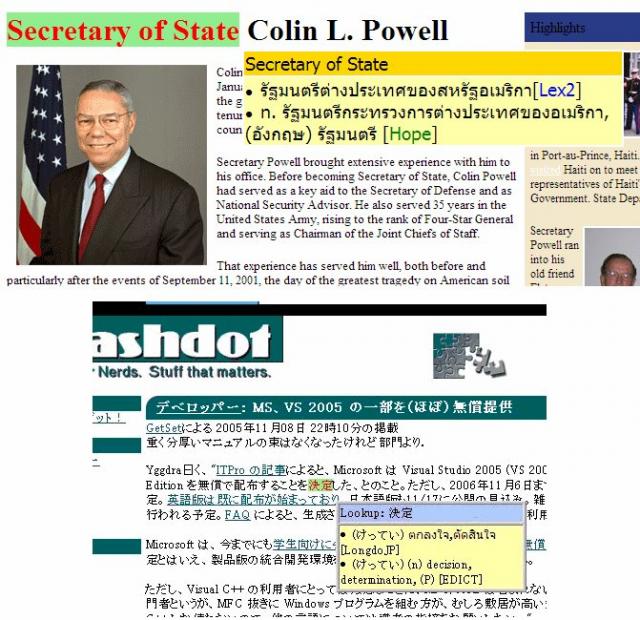
แสดงได้ทั้งความหมายของคำเดี่ยว และคำผสม ได้อย่างถูกต้อง
เช่น Secretary of State=รัฐมนตรีต่างประเทศของสหรัฐฯ (ในภาพตัวอย่าง),
High school=โรงเรียนมัธยมปลาย