(n) the ambiguity of an individual word or phrase that can be used (in different contexts) to express two or more different meanings, Syn.lexical ambiguity, Ant.monosemy
(n) a polymer of styrene; a rigid transparent thermoplastic, Example: expanded polystyrene looks like a rigid white foam and is used as packing or insulation
n. [ Gr. &unr_; farseeing; poly`s much, many + &unr_; to view: cf. F. polyscope. ] 1. (Opt.) A glass which makes a single object appear as many; a multiplying glass. Hutton. [ 1913 Webster ]
2. (Med.) An apparatus for affording a view of the different cavities of the body. [ 1913 Webster ]
a. [ Poly- + silicic. ] (Chem.) Of or pertaining to compounds formed by the condensation of two or more molecules of silicic acid. [ 1913 Webster ]
Polysilicic acid (Chem.), any one of a series of acids formed by the condensation of two or more molecules of silicic acid, with elimination of water. [ 1913 Webster ]
n. [ L. polyspaston, fr. Gr. &unr_;, fr. &unr_; drawn by several cords; poly`s many + &unr_; to draw: cf. F. polyspaste. ] (Surg.) A machine consisting of many pulleys; specifically, an apparatus formerly used for reducing luxations. [ 1913 Webster ]
‖n. pl. [ NL., from Gr. poly`s many + &unr_;, &unr_;, mouth. ] (Zool.) A division of trematode worms having more two suckers. Called also Polystomea and Polystoma. [ 1913 Webster ]
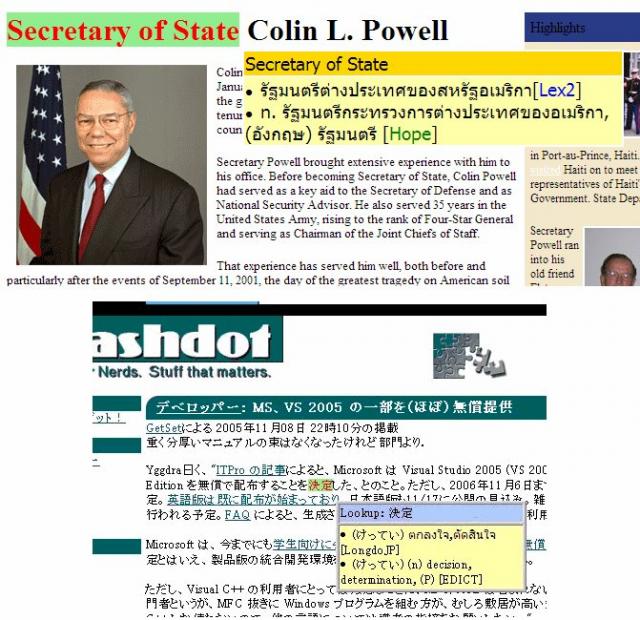
แสดงได้ทั้งความหมายของคำเดี่ยว และคำผสม ได้อย่างถูกต้อง
เช่น Secretary of State=รัฐมนตรีต่างประเทศของสหรัฐฯ (ในภาพตัวอย่าง),
High school=โรงเรียนมัธยมปลาย