[aojaisai] (v, exp) EN: look after ;pay attention ; take an interest in ; attend ; care ; be conscientious FR: prendre soin ; s'occuper de ; être attentif à ; être soucieux de
[arai na] (x) EN: pardon ? ; what did you say, please ? ; what ? ; what ! FR: pardon ? ; pouvez-vous répéter, s'il vous plaît ? ; qu'est-ce qu'il y a ? ; hein ? (fam.)
[reru ; rareru] (aux-v, v1) (1) (れる for 五段 verbs, られる for 一段. Follows the imperfective form of (v5) and (vs) verbs) (See 未然形, 迷惑の受身・めいわくのうけみ) indicates passive voice (inc. the "suffering passive"); (2) (no imperative form. Infrequently used in modern Japanese, e.g. 歩ける is favoured over 歩かれる) (See ら抜き言葉・らぬきことば) indicates the potential form; (3) (no imperative form) indicates spontaneous occurrence; (4) (hon) (no imperative form) used as an honorific for others' actions #41[Add to Longdo]
[seru ; saseru] (aux-v, v1) (1) (せる is for 五段 verbs, させる for 一段; follows the imperfective form of (v5) and (vs) verbs; senses 1-3 of せる are sometimes abbreviated as 〜す) auxiliary verb indicating the causative; (2) (hum) (usu. as 〜(さ)せてもらう, 〜(さ)せていただく, etc.) auxiliary verb indicating that one has been granted the permission to do something; (3) auxiliary verb used to make verbs more "active"; (4) (hon) (as 〜(さ)せられる, 〜あら(さ)せられる, 〜(さ)せ給う, etc.) auxiliary verb used as an extreme honorific for others' actions #540[Add to Longdo]
[sasu] (v5s, vt) (1) (See 為せる・1) to make (someone) do; (2) (See 為せる・2) to allow (someone) to; (aux-v, v5s) (3) auxiliary verb indicating the causative; (4) auxiliary verb indicating that one has been granted the permission to do something; (5) auxiliary verb used to make verbs more "active"; (6) auxiliary verb used as an extreme honorific for others' actions; (n) (7) (arch) swidden #14,090[Add to Longdo]
[シービー, shi-bi-] (n) (1) Citizens' Band; CB (radio); (2) (See 転換社債) convertible bond; (3) (See 慢性気管支炎) chronic bronchitis; (4) chemical and biological (weapons); (5) (See センターバック) center back; (6) community business [Add to Longdo]
[えんがちょきった, engachokitta] (exp) (chn) (See えんがちょ・1) phrase used (usu. with accompanying crossed fingers gesture) to ward off catching 'dirtiness' from another child [Add to Longdo]
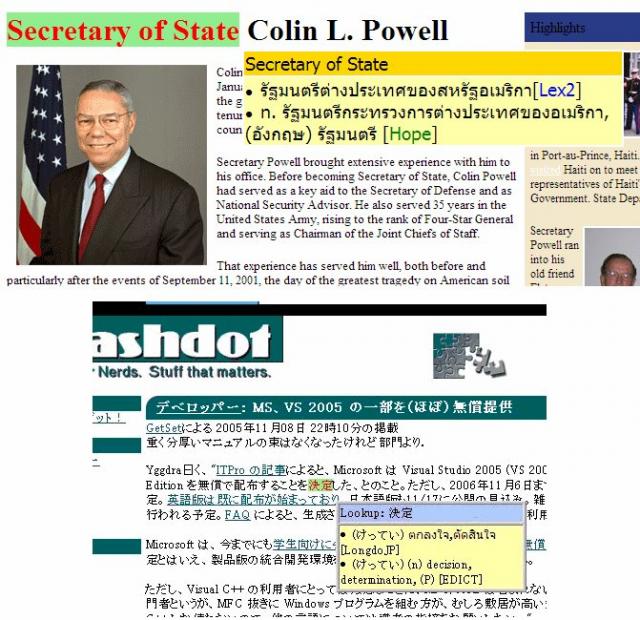
แสดงได้ทั้งความหมายของคำเดี่ยว และคำผสม ได้อย่างถูกต้อง
เช่น Secretary of State=รัฐมนตรีต่างประเทศของสหรัฐฯ (ในภาพตัวอย่าง),
High school=โรงเรียนมัธยมปลาย